Event Information
Contact us for package information
Course Outline:
The Athens Marathon begins at the historic battlefield in the town of Marathon, where runners gather in a calm rural setting before starting the race with a slight downhill over the opening 4 km, allowing them to ease into rhythm as they move toward Marathonomachon Street and the Marathon Tomb, circling the ancient burial mound for roughly 2.2 km as they pass this powerful reminder of the battle that gave the race its name.
Leaving the Marathon area, the course continues toward Nea Makri between 6–10 km, offering coastal views of the Aegean Sea on one side and rolling inland hills on the other, with terrain that is generally flat but subtly undulating as runners warm up for more difficult miles to come.
From around 10 km onward, the route begins its first meaningful climb as it heads toward Pikermi, with the elevation rising consistently across several kilometres and demanding early energy conservation; this uphill stretch intensifies from 15 km onward as the grade steadily increases.
The toughest part of the marathon spans approximately 20–31 km, a long and relentless ascent through Pikermi toward Stavros and Agia Paraskevi, forming the race’s most physically taxing portion, where the continuous climbing reaches its peak near Stavros—recognised as the course’s highest point—before eventually easing.
After reaching roughly 31 km, runners begin to feel the first relief as the route transitions from sustained climbing into a gradual but extended descent leading into the suburbs of Athens, with the downhill continuing steadily past Rafina’s notorious incline zone and toward the wide avenues approaching the city centre.
As the course reaches approximately 38–40 km, runners enter Athens proper, where the streets become increasingly packed with cheering spectators and the terrain remains gently downhill, guiding them toward some of the city’s most recognisable central roadways.
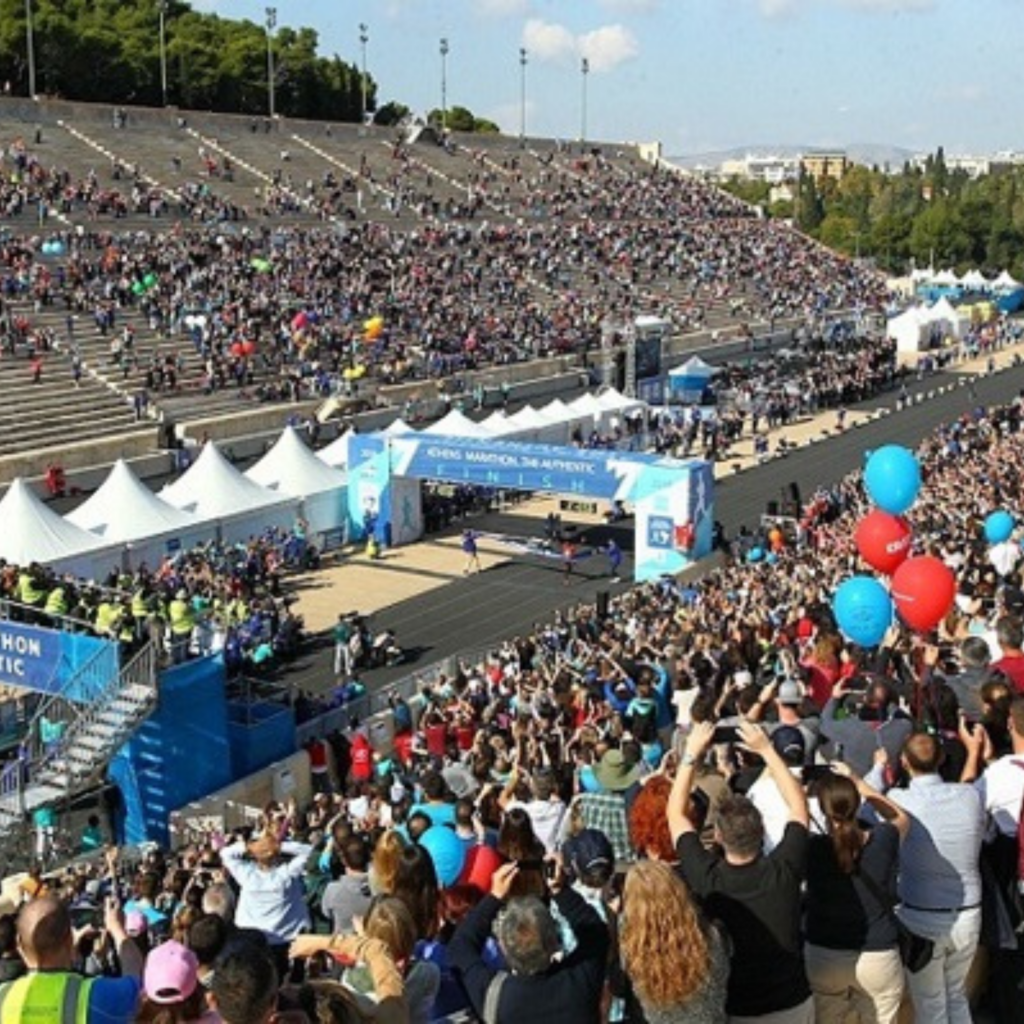
The final stretch carries runners through the heart of the capital and into the majestic Panathenaic Stadium—built of white marble and home to the first modern Olympic Games in 1896—where the crowd’s roar fills the arena, and the marathon concludes with one of the most iconic finishes in the sport.